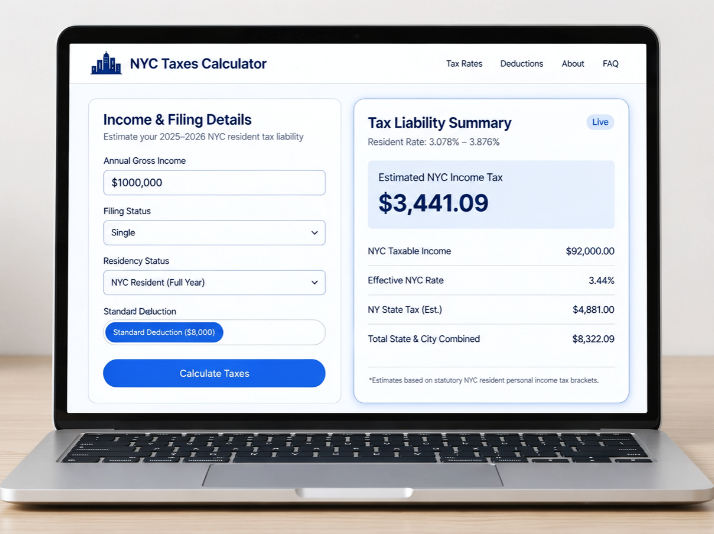
Living in New York City can make a paycheck look different from the salary in your offer letter. The NYC taxes calculator helps estimate federal, state, city, Social Security, and Medicare taxes. It can also show roughly how much income remains for your monthly budget. Direct answer: An NYC tax estimate usually includes federal income tax, New York State income tax, New York City resident tax, Social Security, and Medicare. Your final result depends on income, filing status, deductions, credits, residency, and other details. A calculator provides an estimate rather than an official tax return.
NYC Tax Information at a Glance
| Tax or factor | 2026 rule or rate | Who generally pays it |
|---|---|---|
| Federal income tax | 10% to 37% marginal rates | Taxable U.S. filers |
| New York State income tax | 3.9% to 10.9% rate schedule | New York residents and certain nonresidents |
| NYC resident income tax | 3.078% to 3.876% | New York City residents |
| Social Security | 6.2% on employee wages up to $184,500 | Most employees |
| Medicare | 1.45% on covered employee wages | Most employees |
| Additional Medicare withholding | 0.9% after an employer pays over $200,000 in wages | Certain higher-paid employees |
| 2026 federal standard deduction | $16,100 single; $32,200 joint; $24,150 head of household | Eligible federal filers |
| NY standard deduction | $8,000 single; $16,050 joint; $11,200 head of household | Eligible New York filers |
The IRS kept seven federal marginal rates for 2026, ranging from 10% through 37%. The federal standard deduction also increased for the 2026 tax year. New York introduced lower state rates for several income ranges beginning in 2026. New York City withholding calculations did not receive the same legislative rate change.
How an NYC Taxes Calculator Works

A calculator starts with your income and filing status. It then applies deductions before calculating taxes under the relevant schedules. The result can estimate annual taxes, effective rates, and take-home income. Your federal calculation is separate from your New York calculation. New York also uses its own deductions and taxable-income rules. NYC resident tax then adds another local income-tax layer for qualifying city residents. Payroll taxes require another calculation. Most employees pay Social Security and Medicare through paycheck withholding. These amounts are different from federal, state, and city income taxes.
Information You May Need
For a more useful estimate, prepare the following.
* Annual salary or expected wages * Federal filing status * NYC residency status * Pre-tax retirement contributions * Eligible deductions * Dependents and available credits * Other taxable income * Self-employment income, when applicable
Small input changes can noticeably affect the result. A traditional workplace retirement contribution may reduce income subject to certain income taxes. Credits can also reduce final liability after the initial tax calculation. If you’re comparing your earnings with your bank deposit, Marketries explains the difference in its gross pay versus net pay guide. Gross salary alone does not show the amount available to spend. Payroll deductions explain much of that difference.
What Taxes Do NYC Residents Pay?
New York City residents can face several taxes on the same stream of earnings. These taxes do not all use one rate or one taxable-income definition. Understanding each layer makes a calculator result easier to interpret.
Federal Income Tax
Federal income tax uses progressive brackets. A higher bracket does not apply its rate to every dollar you earn. Instead, each portion of taxable income is taxed within its applicable bracket. For 2026, the federal rates remain 10%, 12%, 22%, 24%, 32%, 35%, and 37%. A single filer’s standard deduction is $16,100 for the year. Married couples filing jointly generally receive a $32,200 standard deduction.
New York State Income Tax
New York State also applies graduated personal income-tax rates. Its 2026 rate schedule, published in the New York State tax rates and tables, begins at 3.9% and rises with taxable income. High-income taxpayers can reach rates of 9.65%, 10.3%, or 10.9%. State deductions differ from federal deductions. The 2026 New York standard deduction is $8,000 for many single filers. It is $16,050 for married couples filing jointly.
New York City Resident Income Tax
NYC imposes a personal income tax on city residents. Its resident rate schedule ranges from 3.078% to 3.876%. The applicable brackets differ according to filing status. A commuter who works in Manhattan but lives outside NYC generally has a different situation. Working inside the five boroughs alone does not automatically create NYC resident income tax. Residency is therefore an important calculator input.
Social Security and Medicare
Social Security withholding is 6.2% for employees in 2026. It applies to covered earnings up to the $184,500 Social Security wage base. Medicare withholding is normally 1.45% and has no comparable wage ceiling. Employers also withhold an additional 0.9% Medicare tax after paying an employee more than $200,000 during a calendar year. Final Additional Medicare Tax liability can depend on filing status.
Example: NYC Taxes on a $100,000 Salary
Consider a single NYC resident earning $100,000 in wages during 2026. Assume the taxpayer uses standard deductions and has no special credits. This simplified example helps show how several tax layers combine.
| Estimated item | Approximate annual amount |
|---|---|
| Gross salary | $100,000 |
| Federal income tax | $13,170 |
| Social Security | $6,200 |
| Medicare | $1,450 |
| New York State income tax | $4,861 |
| NYC resident income tax | $3,441 |
| Approximate amount after listed taxes | $70,878 |
The federal figure uses the 2026 single standard deduction and progressive federal brackets. The New York estimate uses an $8,000 state standard deduction and the 2026 state schedule. The city estimate applies NYC’s graduated resident rates to New York taxable income. This example does not include every possible credit, deduction, benefit, or payroll item. Health coverage, retirement contributions, paid family leave, and other deductions may change a paycheck. Your employer’s withholding can also differ from final tax liability.
Marginal Tax Rate vs Effective Tax Rate
Your marginal rate applies to your next taxable dollar within a tax system. Your effective rate compares total tax with a broader income amount. These percentages answer different questions. Someone in a 22% federal bracket does not normally pay 22% on every taxable dollar. Lower portions of taxable income are taxed at lower federal rates first. Progressive brackets make the final effective federal rate lower than the top applicable marginal rate. The same distinction matters when viewing combined NYC estimates. Adding marginal percentages from different taxes does not equal your effective total burden. A good calculator should keep those concepts separate.
Why Your Actual Paycheck May Be Different
A tax calculator estimates liability using the information entered. Payroll withholding instead follows employer withholding rules and information from forms such as Form W-4. The two figures can differ during the year. Bonuses, overtime, commissions, multiple jobs, and midyear salary changes can affect withholding. Retirement contributions and benefit elections can also change taxable wages. Credits usually require more personal information than a simple salary calculator collects. Side income creates another complication. A worker receiving independent-contractor income may need estimated payments and self-employment tax planning. Marketries covers that distinction in its side-hustle jobs guide.
NYC Resident vs Nonresident: Why Location Matters
The NYC personal income tax is primarily a resident tax. Someone living in Brooklyn or Queens can face city tax alongside New York State tax. A person commuting from another jurisdiction can have different local obligations. Moving during the year can make residency more complicated. Part-year residency, domicile questions, and multiple homes can require additional analysis. A simple calculator should not replace professional guidance for disputed residency situations. Keep records supporting where you lived and worked if your situation changes. Organized tax and payroll records are useful during filing and review. Marketries’ business documents guide also explains why financial and tax records matter.
How to Get a Better Tax Estimate
Start by entering accurate annual income rather than guessing from one paycheck. Choose the correct filing and residency status. Then include known pre-tax deductions and other taxable earnings. Review your estimate whenever your circumstances change. A new job, marriage, move, second income source, or large bonus can alter the calculation. Updating the numbers gives you a more useful planning estimate. Use the result for budgeting rather than treating it as a guaranteed tax bill. Compare estimated take-home income with recurring living costs and savings goals. Marketries also discusses ways to separate saving from everyday spending in its personal savings account guide.
Use the Calculator Before Planning Your NYC Budget
NYC residents can have federal, state, city, and payroll taxes deducted from earnings. Looking only at gross salary can therefore overstate spendable monthly income. A tax estimate helps translate salary into a more realistic planning figure. Enter your current income, filing status, residency, and available deductions into the calculator. Review the breakdown instead of focusing only on the final take-home figure. Each tax line explains where part of your gross income goes. Use the estimate for salary comparisons, budgeting, or withholding reviews. Check official IRS and New York guidance when your circumstances are complex. A qualified tax professional can address situations that a general calculator cannot model.
Frequently Asked Questions
What percentage of income tax do NYC residents pay?
NYC resident income-tax rates range from 3.078% to 3.876%. These are marginal city rates rather than a single flat percentage on gross salary. Federal and New York State taxes are calculated separately.
Does NYC tax everyone who works in the city?
No, working in New York City does not by itself make every worker subject to NYC resident income tax. City residency is a key factor when determining this tax. Special circumstances can still require closer review.
Is an NYC taxes calculator exact?
An NYC taxes calculator provides an estimate based on the information and assumptions entered. Actual liability can change because of deductions, credits, other income, and residency details. Employer withholding can also differ from your final return.
Does the calculator include Social Security and Medicare?
A take-home-pay calculator should normally show these payroll taxes when estimating employee net pay. Social Security is 6.2% on covered employee wages up to $184,500 in 2026. Medicare is generally 1.45% on covered employee wages without that wage cap.
How can I reduce the gap between salary and take-home pay?
You cannot remove taxes that legally apply to your income. You can make sure withholding information and eligible pre-tax benefits are correctly reflected. Tax credits and deductions may also reduce liability when you qualify.
Should I use gross salary or taxable income?
Start with gross earnings when the calculator specifically asks for salary. The calculator can then apply supported deductions to estimate taxable income. Do not subtract the same deduction twice.