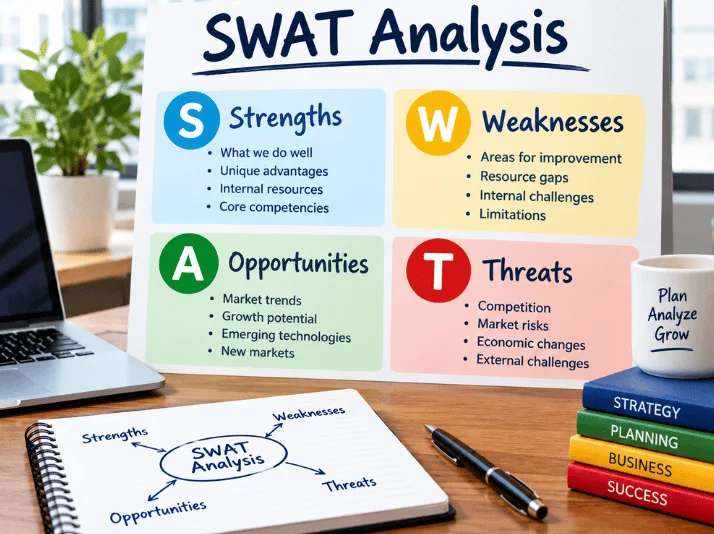
A SWAT analysis usually refers to the business framework, correctly spelled SWOT analysis. SWOT stands for strengths, weaknesses, opportunities, and threats. It helps U.S. businesses evaluate their position before making strategic decisions.
The framework separates factors your company controls from conditions outside its control. Strengths and weaknesses are internal, while opportunities and threats are external. That distinction makes the analysis useful for planning, marketing, product development, and competitive research.
Direct answer: A SWOT analysis, commonly spelled SWOT analysis, examines a business’s strengths, weaknesses, opportunities, and threats. Strengths and weaknesses cover internal factors the company can influence. Opportunities and threats cover external market conditions. Businesses use the findings to set priorities, manage risks, and identify practical growth opportunities.
SWAT Analysis at a Glance
| Area | Type | Main Question | Business Example |
|---|---|---|---|
| Strengths | Internal | What do we do well? | Strong customer retention |
| Weaknesses | Internal | Where are we underperforming? | Limited marketing budget |
| Opportunities | External | Where can we grow? | Rising demand in a new segment |
| Threats | External | What could hurt performance? | New competitors entering the market |
Key Takeaways
- SWOT is the standard spelling, although people sometimes search for “SWAT.”
- Strengths and weaknesses examine factors within your business.
- Opportunities and threats examine outside market conditions.
- Evidence should support each item instead of assumptions.
- The finished grid should lead to specific business actions.
- Regular reviews help businesses respond to changing U.S. market conditions.
What Is a SWAT Analysis in Business?
The standard business term is SWAT analysis, not SWAT. Still, the alternative spelling appears in searches and even some educational materials. Both searches usually point toward the same strategic planning method.
A SWOT review gives decision-makers a structured picture of a company or project. It can cover an entire organization, one product, or a marketing campaign. You can also use it before entering a new geographic market.
The framework is simple, but useful analysis requires evidence. Generic claims such as “good service” offer little strategic value. Specific observations make the findings easier to turn into decisions.
For example, “strong customer service” is broad and difficult to measure. A better strength might identify high retention or consistently positive customer feedback. Specific findings give your team something concrete to protect or expand.
The Four Parts of a SWAT Analysis
Understanding the four categories prevents one of the most common SWOT mistakes. Internal capabilities belong under strengths or weaknesses. Market conditions outside your direct control belong under opportunities or threats.
Strengths
Strengths are internal advantages that support your business goals. They can include expertise, intellectual property, efficient operations, strong customer relationships, or financial resources. A strength should have meaningful value compared with alternatives available to customers.
American small businesses might identify local recognition or specialized expertise as strengths. Larger companies could have distribution advantages, proprietary technology, or extensive customer data. The strongest entries connect directly to competitive performance.
Avoid filling this section with statements every competitor could make. “We care about customers” doesn’t identify a meaningful advantage. Look for evidence showing where your company performs differently or consistently well.
Weaknesses
Weaknesses are internal limitations that can reduce performance or restrict growth. Examples include outdated systems, limited capital, skill gaps, poor customer retention, or dependence on one acquisition channel. These factors are generally areas the business can influence.
Treat weaknesses as operating facts rather than failures. Honest analysis can expose problems before they become expensive. It can also help managers decide where additional resources will produce the greatest benefit.
A business relying heavily on one large customer has concentration risk. A retailer with poor mobile usability may lose potential online sales. Naming the weakness clearly creates a starting point for improvement.
SWAT Analysis: Opportunities Businesses Should Examine
Opportunities come from external changes that a company could use to its advantage. These might include new customer needs, technological developments, demographic shifts, or competitor weaknesses. Geographic expansion can also create opportunities for businesses with proven demand.
Technology is creating several areas worth examining for U.S. companies. Artificial intelligence can change research, customer support, analytics, and routine administrative work. Businesses should judge these possibilities against customer needs rather than adopting technology without a clear purpose.
Digital channels can create additional openings for smaller companies. Search visibility, useful content, social platforms, and email can help businesses reach specific audiences. Marketries’ coverage of digital marketing and brand identity offers related ideas for building a consistent online presence.
Opportunities should still pass an evidence test. A growing trend doesn’t automatically represent a profitable market. Check demand, customer fit, expected costs, and your ability to execute.
Threats
Threats are outside conditions that could weaken your results. Common examples include new competitors, economic pressure, regulatory changes, shifting customer expectations, or technology changes. Businesses cannot control these factors directly, but they can prepare for them.
Digital businesses also face platform and algorithm dependence. A company relying on one search engine or advertising network can face sudden performance changes. Diversifying acquisition channels can reduce that exposure.
Operational threats deserve similar attention. Cybersecurity incidents, supply disruptions, and unexpected physical risks can affect smaller companies significantly. The Marketries guide to protecting a business from unforeseen risks provides useful context for broader risk planning.
How to Conduct a SWOT Analysis Step by Step

A productive analysis needs more than four brainstorming lists. You need a defined objective, reliable information, and a process for prioritizing findings. The following steps keep the exercise connected to actual business decisions.
- Define the decision. Decide whether you are evaluating your whole company, a product, a marketing plan, or market expansion.
- Collect evidence. Review sales data, customer feedback, financial results, website analytics, competitor information, and employee observations.
- Identify external factors. List market opportunities and threats before deciding how your internal capabilities fit them.
- List internal factors. Document strengths and weaknesses that affect your ability to compete or reach the stated objective.
- Remove generic entries. Replace vague statements with specific observations supported by evidence.
- Prioritize each quadrant. Focus on the factors with the greatest likely business impact.
- Connect the quadrants. Determine which strengths can capture opportunities and which weaknesses increase exposure to threats.
- Assign actions. Give important priorities an owner, deadline, and measurable result.
The process works best when several perspectives contribute. Owners may understand financial constraints, while customer-facing teams see recurring complaints. Marketing and sales teams can contribute information about demand and competitors.
Keep the final grid manageable. A list containing dozens of items can obscure the factors that deserve attention. Five strong observations in each quadrant usually provide more value than a long collection of vague ideas.
A Practical SWOT Analysis Example
Consider a small U.S. retailer planning to increase online sales. Its physical store has strong customer loyalty and knowledgeable employees. Yet its website attracts limited organic traffic and performs poorly on mobile devices.
Its external opportunities might include increased online demand within its product category. Competitors may also have weak educational content, creating room for useful search-focused resources. Rising advertising costs and larger online competitors could represent threats.
The resulting grid might look like this:
| Strengths | Weaknesses |
|---|---|
| Loyal existing customers | Weak organic search visibility |
| Experienced product staff | Poor mobile website experience |
| Strong local reputation | Small advertising budget |
| Detailed product knowledge | Limited customer email data |
| Opportunities | Threats |
|---|---|
| Growing online demand | Larger e-commerce competitors |
| Educational search content | Rising paid advertising costs |
| Email retention campaigns | Changing search algorithms |
| Improved mobile shopping | Economic pressure on buyers |
The grid immediately suggests several priorities. The retailer could turn staff expertise into helpful content and improve mobile usability. It could also build owned customer channels instead of depending entirely on paid acquisition.
Website experience deserves special attention in this example. Marketries explains several factors affecting website user experience, including usability, accessibility, and findability. Those factors can help teams examine a digital weakness more precisely.
Turn Your SWOT Grid Into a Strategy
Completing the grid is only the first half of the exercise. The real value appears when you connect findings and choose actions. Otherwise, SWOT becomes another planning document that nobody uses.
Start by pairing strengths with opportunities. Ask which existing advantages make an external opening easier to pursue. A company with strong technical expertise might use that knowledge to address an underserved customer question.
Next, examine weaknesses that prevent you from capturing opportunities. A growing market means little if your company lacks capacity or distribution. This comparison helps determine which internal improvements deserve investment first.
Finally, connect threats with your weakest areas. A business dependent on one supplier becomes more exposed when supply conditions become unstable. The combination deserves greater attention than either observation alone.
Common SWOT Analysis Mistakes
The first mistake is confusing internal and external factors. Competition is usually a threat because the company cannot directly control competitors. Poor customer service is generally a weakness because management can change processes and training.
Another mistake is treating opinions as evidence. Ask what data supports every important entry. Customer surveys, financial reports, analytics, market research, and competitor observations can improve the quality of the discussion.
Teams also create problems by listing too many factors. Prioritization matters because resources are limited. Your analysis should help decide what deserves attention now.
The final mistake is failing to revisit the document. Markets, technology, customer expectations, and company capabilities change. Review your SWOT after major business changes or during regular strategic planning.
When Should a Business Perform a SWOT Analysis?
Businesses can use SWOT during annual or quarterly planning. It is also useful before launching products, entering markets, changing pricing, or making major investments. Startups can apply it when testing positioning and identifying competitive gaps.
Established businesses may use the framework when performance changes unexpectedly. Falling sales, rising acquisition costs, or new competitors can justify a fresh review. The exercise helps separate internal problems from external pressures.
A focused review can also support marketing decisions. Companies assessing brand positioning can combine SWOT findings with broader digital marketing strategy. This connection keeps promotional decisions tied to business realities.
Frequently Asked Questions
What does SWAT analysis mean in business?
A SWAT analysis generally means SWOT analysis in a business context. SWOT stands for strengths, weaknesses, opportunities, and threats. The framework helps organizations compare internal capabilities with external market conditions.
What is the difference between SWOT and SWAT analysis?
SWOT is the recognized acronym used in strategic planning. “SWAT” is commonly a misspelling or phonetic variation used when searching for the framework. Business planning resources normally use the spelling SWOT.
What are examples of strengths in a SWOT analysis?
Examples include skilled employees, loyal customers, efficient processes, proprietary technology, or strong brand recognition. A useful strength should support an important business objective. Evidence should show why the factor creates an advantage.
Are competitors a threat or weakness?
Competitors are normally classified as a threat because they exist outside your organization. Weak competitiveness caused by poor service or outdated technology would be an internal weakness. Separating those factors makes the resulting strategy clearer.
How often should a company update its SWOT analysis?
There is no single schedule that fits every organization. Many companies can review it during regular strategic planning and after major market changes. A review is especially useful when launching products or entering new markets.
Make SWOT Analysis Useful, Not Decorative
A good SWOT review should end with decisions rather than four completed boxes. Identify the factors with the greatest impact, connect related findings, and assign clear actions. Then measure whether those actions improve the business outcome you originally defined.
For U.S. businesses, regular analysis can help teams respond to competition and changing customer needs. Keep the process evidence-based and focused on a specific decision. Visit the Marketries strategy section for more practical business planning resources.